


Evosphere – Van Deemter Equation
The primary objective of optimizing this equation is to restrict analyte dispersion along mobile phase flow paths, thereby reducing plate height and improving separation efficiency.
Eddy Diffusion Term (A): This term accounts for the multiple pathways that analyte molecules can travel through the packed column. Minimising this effect involves using uniformly packed Monodisperse (MFPP), small, spherical particles, which reduce the eddy diffusion contribution.
Longitudinal Diffusion Term (B/u): This term describes the natural tendency of analyte molecules to diffuse longitudinally along the column axis due to concentration gradients. Such diffusion can cause peak broadening, especially at low mobile phase velocities, as molecules have more time to disperse. To mitigate longitudinal diffusion, higher flow rates are employed, reducing the time analytes spend in the column and limiting diffusion.
Mass Transfer Term (C·u): This term represents the resistance to mass transfer between the stationary and mobile phases. Analyte molecules may interact differently with these phases, leading to variations in migration speeds and peak broadening. Factors influencing this term include the thickness of the stationary phase and the diffusion coefficients of the analytes. Optimizing these parameters can enhance mass transfer and improve separation efficiency.
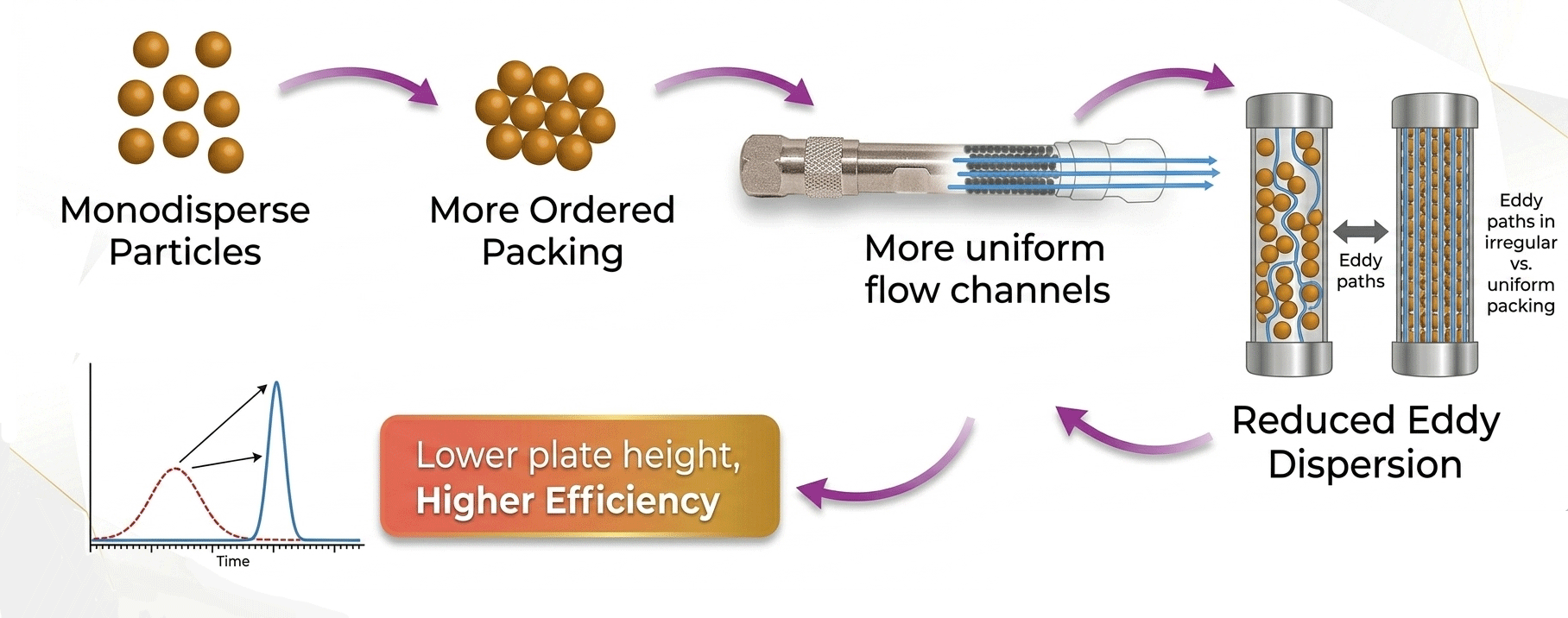
Evosphere Monodisperse Fully Porous Particles allow the HPLC/UHPLC column to have reduced heterogenous packing, leading to more uniform packed beds. Resulting in higher efficiency
Evosphere AQUA

Evosphere C18/AR

Evosphere Diphenyl

Evosphere C18/PFP

Evosphere RP18-Amide

Evosphere PFP

Evosphere Phenyl-Hexyl

Evosphere C12
